Friday, April 8, 2011

Public Sculpture in St. Louis


photo by the author.


Prettiest piece of public art in St. Louis? This canopy by Liam Gillick at Centene's new headquarters in downtown Clayton, MO.

The parking structure (out of the picture, to the right) uses color to mark the levels. While this never makes sense in most parking structures (how many times do you still have to write down the floor number when parking in an urban area?), this one works.

I have no idea what the process was for choosing this artist, but whoever was involved--congratulations! See what a good budget for public art can do?

Wednesday, March 30, 2011

Learning on the Ground


UMSL group at the Met, March 25, 2011.

I just returned from leading the 2011 Ferring Art and Art History Travel Study Program to New York. All happy faces, all tired feet!

We met with dealers like Jay Gorney to see the Kenneth Noland show at Mitchell-Innes & Nash, artists such as Brad Kahlhamer and Ursula von Rydisgsvard, below.

We saw the George Condo and Lynda Benglis shows at The New Museum, Laurie Simmons at Salon 94 on the Bowery, Tim Rollins & K.O.S. at Lehmann Maupin and Paul Ramirez Jonas at Alexander Gray Associates.


Ursula von Rydingsvard at The Sculpture Center. photo by Dr. Karen Cummings.


What struck me most was how many significant, mid-career artists were in the museums and galleries. What a great time to re-invest in these important figures!

Not everything has to be about the go-go kids. Depth and wisdom do have great value in our marketable world.

Saturday, March 12, 2011

Shout it Out!


Washington University campus, St. Louis. photo courtesy the author.


Funny how bullhorns are creeping into my speech these days.

Protestors in the Middle East demanding the creation of civil society.

Protestors in the mid-west trying to stop the dismantling of civil society.

This eerie stage on Wash U's campus looks very Soviet-era, despite the neo-Gothic building in the background.

The speakers on top of the pavilion reminded me of when I was part of a union negotiating team when I worked at the Museum of Modern Art. PASTA-MoMA was part of the white collar division of the United Auto Workers--open shop, of course (this means employees were not obliged to pay union dues but they benefited from the union's work on their behalf).

The lawyer for MoMA complained one morning that he had $1 million worth of damage to trees on his property in Connecticut. We were trying to raise the minimum wage for the front desk workers who made $13,000 a year and had to speak two languages (this was around 1987). It's as if we were on different planets.

I am all for free markets but I believe in the Social Contract that provides a safety net for people less fortunate--like the millions laid off because of the global financial collapse. The arts are part of that civil society / Social Contract that I pay to support--that lots of people pay to support. The arts frame the value of life, giving it texture and meaning.

If we are all not trying to make everyone's life better, then we're in one big open shop--where the majority does the hard work while a minority benefits.

All of our nationals arts foundations--from museums and libraries to public radio and television--are under attack. If you haven't already I urge you to express yourself--even if you disagree with me, take a stand.

Saturday, January 29, 2011

Modeling Business


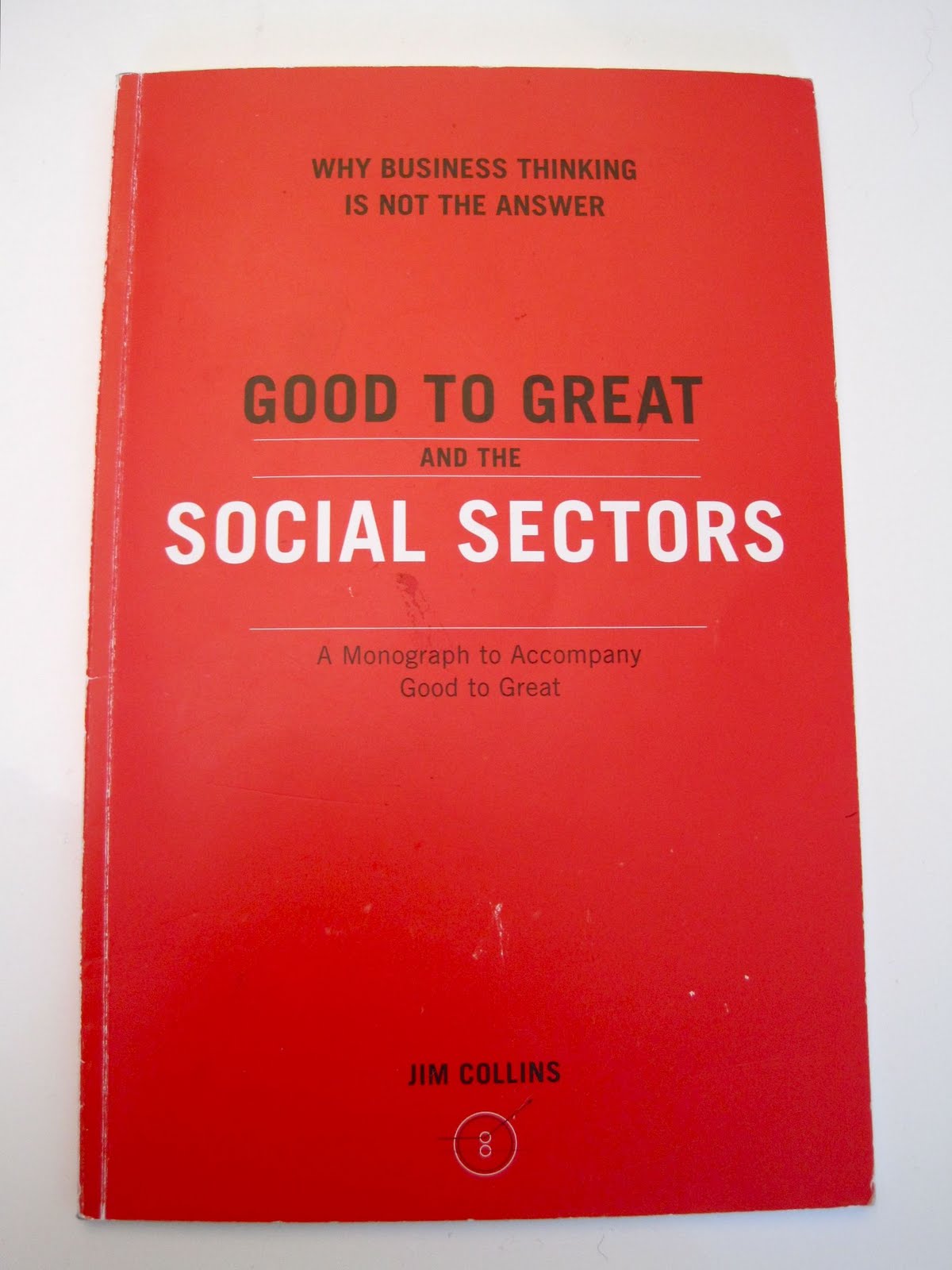
photo courtesy the author.

I am reading "Good to Great and the Social Sectors" by Jim Collins, lent to me by Amy Rome and Leslie Peters of The Rome Group. Amy and Leslie are guiding our Strategic Planning process at Laumeier. Focusing on our sustainable "business model" is the most important element for me in this exercise.

Diane Ragsdale's post, linked to by Andrew Taylor, below, is a helpful at-a-glance in thinking about the elements needed to explain a "business model":
http://www.artsjournal.com/artfulmanager/main/back-to-business-models.php

Yet I like what Taylor (and Collins) say about replacing "value model" for "business model" in how non-profits "sell" their worth to funders and patrons alike.

In the 1980s the arts sector veered away from the intangible values arts organizations bring into the bean-counting territory favored by business leaders and politicians mindful of expenditures of public funds.

Perhaps it's time to re-import the "value" of our proposition back into our non-profit business models. Given the collapse of our economy and the threats to further de-funding, any and all new language we find could be enormously helpful to protect ourselves from the heathens at the door.

It's interesting to, in the same week, listen to radio stories about the creation of a national arts policy under President Kennedy while, simultaneously, the NEA et al are threatened with extinction.

Eliminating NPR and the NEA would not only cause more job losses but fatally crush those independent voices that are not about capital or the monitization of life. We need independent voices in this country when we are so in danger of losing our position as a global social and cultural leader.

Let's put "value" next to arts "business" to stave off the superficial attacks lobbied at us so we stop fighting this battle and instead focus on our social commitments to our constituents. When the economy improves it's crucial that the arts can again lead the country in making our citizens informed and engaged in civic life.

Sunday, January 2, 2011

Southern Architecture


Clinton Library, Little Rock, AR. all photos courtesy the author.


Kevin and I had some whiplash moments during our Southern tour. We left St. Louis and headed to Little Rock, Arkansas, to see the Clinton Library. A very chatty guard was pleased to tell us that, when in town, the Clintons stay on an apartment on top of this building. (See the slight roof-line on top?)

Should we know that? I asked him how they got up there--through the Library? Kevin said I shouldn't have asked so many questions. But what director wants a bunch of beefy Secret Security guys barging in at all hours of the day and night? I vote for an exterior elevator.


Scale West Wing Office.


Best room in the library: this scale model of the President's office. Made me think of Martin Sheen.

For every grand building we saw there was a tenfold volume of buildings that speak of economic decay. For every suspicious thing I've heard or seen about the South, in television, print or the movies, we saw inspiring spaces. For every hardscrabble burg we passed through we saw signs of incredible strength and human glory.


Central High, Little Rock.

What a grand building this is! I never saw the footage of the forced integration of American schools while in school in Canada so had no real idea of what the Little Rock 9 went through to get into this school. The National Parks Service building across the street had poignant, pointed footage on the racial divide that happened right there. The neighborhood around the school? Neglected, degraded. I wonder why?


Beer Can House, Houston.

I talked my family into taking an eating break to go to the Beer Can House (oh, we did do things other than eat and watch movies!) This lovely piece of folk art is trapped between two hideous apartment complexes--who's got the worse view, hmmm? I love the quirky quality of this kind of endeavor, even if it implies the author loved his six pack, just like Hank Hill.


Lower Ninth Ward homes.

While in New Orleans we went looking for the Brad Pitt-sponsored homes in the Lower Ninth Ward. Above, one of the houses that reinterprets the architectural vernacular of the region.


Old Lower Ninth Ward home.

As charming and playful as the new homes are, the area is still strewn with these former residential spaces. I would say 70% of the area is empty. Who is helping here, and why does much of the rest of New Orleans look similarly like ruins?


Downtown Jackson, Mississippi.

Never thought I'd be in Mississippi. The city fathers bulldozed their old downtown places just as efficiently as did towns across the country. This block cringes in the shadow of the larger corporate spaces around it--will these poor lost buildings be saved, or sacrificed, in this latest round of economic downturn? Hard not to think of the Great Depression, or even William Christenberry, when going through this area.


Lorraine Motel, Memphis.


The National Civil Rights Museum in Memphis embraces the Lorraine Motel where Dr. Martin Luther King Jr. was assassinated. When open, visitors can actually go into the rooms above, where King and his associates were staying. Across the street you can stand in the (assumed) location where the murderer stood.

It was haunting to be put in the place of the real protagonists in this pivotal moment of American history. What other artifacts could convey this trauma other than the real spaces where real bodies reside?

The second part of the museum, located on the "bad" (aka murderous) side of the street, explored the various controversies around the King assassination. Mafia, CIA, crackpots all are implicated. (I was shocked to learn that Ray, a Missouri State Penitentiary escapee, had fake Canadian passports to help him move around more easily. How could he NOT have had help?)

It was a very moving experience to see this museum and read a narrative that was bracing and pointed about the social issues swirling around at the time. Hard not to compare and contrast today's society with the issues King was fighting--entrenched poverty, class discrimination, etc... Moving and tough.


Elvis basement.


What better to wash away Southern grit than with Southern flair? Elvis's home was not the McMansion I thought it would be. That his "man cave", above, was in the basement is astounding given Elvis's international reach. The large but, by today's standards, small crib is a testament to not over-spending--on your home, anyway!

Architecture is the thing that we all live in, whether we pay attention to it or not. Architecture is the first one up, the last one down in a good / bad economy. That these experiences were not a flush or over-bearing visual stimulation but rather sought-out experiences tells us about the lack of density in the South. Perhaps it's a good thing that these communities have not over-built--perhaps that temerity is what will save them.

Wednesday, December 29, 2010

Portable, Storable Collection


Bill and Hillary cookie cutters from the Clinton Library, Little Rock, AR. photos courtesy the author.


As my search for the perfect floaty pen continues I believe I have run across a new small collectible: cookie cutters.

Above are two from the Clinton Library's store in downtown Little Rock, Arkansas.

I love that they have a sense of humor about eating either Clinton's head!


Saints cookie cutter, New Orleans.


The down side of this art form is that you better check the work--this cookie cutter from the French Quarter was sub-standard work.

These may be the new small collection that I try, I look forward to understanding what they mean about us.

Tuesday, December 21, 2010

On the Road Again


Hot mulled wine with pomegranate, cinnamon and star anise.


Kevin and I head out on our holiday road trip, but first, tonight, staff party at my house.

I made a new hot mulled wine recipe last night--I love digging the pomegranate seeds out, it feels very true to the season but I don't care for the streaks of red juice that I found everywhere!


Maple leaf cookies.


Happy holidays everyone, I'll write from the road!