Friday, June 24, 2011

Politics in Venice, part 3


Street poster in Venice. All photos courtesy the author.

Again, more politics. This poster was plastered around San Marco, looking like Elizabeth Peyton except for the text. After looking for anti-Catholic posters in Venice I found a lot of interesting things--Venice, perhaps because of its independent stature for so long, wasn't a friend of Rome. Anyone know who did this work?


Song Dong in the Arsenale.

China's Song Dong remains one of my favorite artists with whom I've worked. I commissioned him to do a work for my show Water, Water Everywhere... at the Scottsdale Museum of Contemporary Art. His work is thoughtful and meditative, like this ramshackle construction that suggests a labyrinth and a soon-to-be-destroyed warren of alleys. Several works were also embraced inside the walls of this construction--hiding out or finding other meanings?


Liina Siib in the Estonian pavilion.


In her project Woman Takes Up Less Space in the Estonian pavilion, Siib challenges the assertion in Estonia that since women take up less space they can be paid lower salaries. In the un-fancy apartment Siib creates tweaked rooms with the images and words of Estonian women jumping off the wall. The work was funny and very sad.


Faycal Baghriche in The Future of a Promise.

Loved this madly spinning globe by Faycal Baghriche. It reminded me of Charlie Ray's spinning disc set flush into a wall--its effects almost invisible but certainly deadly.


Maria Rosa Jijon in the Latin American pavilion in the Arsenale.

Finally, one of the compelling political videos in the Latin American pavilion.

Tuesday, June 21, 2011

Beauty in Venice, part 2


San Marco, May 29, 2011. All photos courtesy the author.


After hunting down as many outlying pavilions for the Bienniale as I could find, I feel I know Venice better than I ever have. The tourist count wasn't as high as it will get, and anyway, tourists did not touch the alleyways where international art would be found.


View from Museo Correr.

I had never been to Museo Correr, and Rick Steve's guide book was right: great view of San Marco from the windows still unobstructed by scaffolding.


View of canal from installation Days of Yi.

I would suspect most tourists would be mortified to see this open window, I thought about the Renaissance.


Building style exposed.


Impressive--look at the size of those beams. No wonder Italy is almost denuded, they've been building for thousands of years.


Saint in l'Accademia.

It's hard to find decent small gifts in Venice--too many kitschy glass gondolas, way too many Carnivale masks (perfect only for 12 1/2 year old girls). I loved this painting at l'Accademia--a saint whose mask looks back. Too bad there wasn't any information about who this was--where is my "Dictionary of Saints and Symbols" when I need it?


Conservation methods at l'Accademia.

L'Accademia's state of repairs is rather shocking. I saw many wall patches that looked like hastily-bandaged war wounds scattered throughout the building. The first floor, where all my favorite proto-Renaissance works were shown, was virtually unairconditioned--and we all know the effects of humidity on wood and paint.

Nothing like the slick and elegant spaces of Francois Pinault's Palazzo Grassi (no pics here, they are forbidden). Perhaps some wealthy collectors could spend a little less on themselves and toss a few bones to the public institutions in Italy that are clearly starving?

With the public in Italy fed up with the antics of their clownish government, I hope they will insist on protecting the Italian culture that has so influenced virtually every artist, almost around the globe, for centuries. When I worked with Yoshitomo Nara in the 1990s he told me that Giotto was a big favorite of his--see the connection? This historical work is important to all of us in the arts.

Friday, June 17, 2011

Politics in Venice, part 2


Llyn Foulkes, Central Pavilion. All photos courtesy the author.

Imagine my surprise to see a room of Llyn Foulkes works at the Giardini. This under-rated LA-based painter has made powerful, disconcerting works since the 1960s. His presence made me appreciate the diligence with which Bice Curiger curated the show (although not sure that the historical works in the first room of the pavilion made sense).


Erwin Wurm.

Erwin Wurm's skinny house, just beside the Accademia bridge, is based on his parent's home and mocks the over-consuming lifestyles in the West. This modest profile fits with Venice however, a city where even the most grandiose palazzo doesn't match the egregious waste of resources or space of a modern McMansion.


Yael Bartana, Polish pavilion.

The presence of an Israeli artist in the Polish pavilion is an example of inspired national cross-over. Bartana imagines a political movement in Poland that begs Israelis of Polish descent to return, re-populate the country and save Poland from a death of homogeneity. One would understand Israeli's not falling for it, but the language was blunt and overt, bemoaning the evil act of killing Jews or forcing them to flee during World War II. Very interesting timing for this work.


Christian Marclay, Arsenale.

I finally got to see at least part of Christian Marclay's work about time. I read all the NY reviews of the work and finally understood the operatic, deeply meditative pleasure of the work. We passed our time with the piece from 2:25 to 3:50 pm, resting on the (uncomfortable) couches yet mesmerized by the ease with which I created mini-historical narratives I made up while watching.


Segalit Landau, Israeli pavilion.

Finally, Segalit Landau's lovely installation looking at water politics in Israel was both sweet and stifling. Through different videos she narrated the struggle for cooperation between political enemies for the appropriate management of water. This video, of a little girl tying together the shoelaces of negotiating politicians, made the most pertinent point--everyone is tied together whether they like it or not, so harming one's enemy is harming oneself.

Simple but effective.

Wednesday, June 15, 2011

Beauty in Venice, part 1


Gondola in Venice near Rialto Bridge. All photos courtesy the author.

Politics and beauty may be the two organizing guides I had while in Venice. Yes, yes, Venice is beautiful. I read that 58,000 people live there while 15,000,000 visitors inundate the city per year. No wonder the city is sinking with all those well-fed Western European and American visitors.


Yuan Gong, Arsenale.

I found beauty everywhere. This gorgeous installation by Yuan Gong was a floating palace of dreams, a respite from the slogging through the Giardini (and a calming influence before the bad few shows that were to follow).


Shada & Raja Alem, Arsenale.

This decorative piece was hard to comprehend in the dark; a floating disc of black loomed above an oval carpet of patterns. A visual interpretation of experience at Mecca perhaps, or a not-so-subtle commentary on the dampening effect religion has on the intricate web of relations between people in the Middle East?


Raafat Ishak, The Future of a Promise.

Raafat Ishak's multi-paneled painting in the Pan-Arab show interpreted the hundreds of requests made for visas and his rejection by this many governments. This playful Easter egg hunt was soothing yet fragile in its delicacy--surely reflecting the fragility of the situation lived by immigrants across the world seeking a better life.


Karla Black, Scottish corollary pavilion.

I loved this installation by Scottish artist Karla Black despite feeling I had seen this type of installation decades ago in LA. This fugitive, diy-craft-y material installation both harkens to the 1960s feminist movement and the 1980s LA garage-style works shown at places like FoodHouse. The aesthetic has seeped into art schools across the country. As a Scottish artist her aesthetic reference must be different--this is the kind of detail that was missing in the written materials at the show.


Oksana Mas, Ukrainian pavilion.

Speaking of eggs, we found this installation by Ukrainian artist Oksana Mas in a church near La Fenice. The artist used thousands of painted eggs to re-create a Byzantine mosaic of Christ. This year I saw more art works based on religious forms than ever-before--interesting that artists are commenting on the (perhaps hollow) overwhelming presence of religious life in Venice.


Taibamo, Japanese pavilion.


Taibamo's enveloping video animations are disconcerting dreamscapes where land and water merge and reverse positions. The gooey tentacles of seaweed caress and obscure in this mesmerizing but somewhat confounding installation.

Long live Beauty!

Saturday, June 11, 2011

Politics in Venice


Horse statue in Venice. All photos courtesy the author.


What a relief to see a lot of art and to see a lot of artists dealing overtly with political topics. This year's Venice Biennale was of a minimum guaranteed quality (except where it was shockingly bad), but that sometimes makes for a sluggish show overall. I was thrilled to get a jolt of recognition through works addressing a range of contemporary issues although not each work was equally successful.

I espied Verrocchio's Colleoni Monument, started in 1479, while taking refuge under an umbrella to escape a hot day slogging between far-flung pavilions scattered around the city. Colleoni is a master of the universe but Verrocchio presents us with a brutish boor of a conquerer. (Art has always been political in some form or another, and denying that make the speaker seem very dull indeed.)


Adel Abidin work in the Iraqi pavilion.


I found Adel Abidin's video and installation a funny antidote to Verrocchio's conquering hero. Two white guys play Star Wars with fluorescent tubes from the office ceiling light; the choreographed dance made a nice mockery of the powers fighting over (name one) Middle East country.


Ahmet Mater.

Ahmet Mater's work in the show The Future of a Promise mocks the simplistic political creed of the former US government that started two wars in the Middle East.


Allora & Calzadilla tank.


Jennifer Allora & Guillermo Calzadilla's installation Gloria at the American pavilion too made hay with politics. The sub-theme was war as competitive game. The best of their work is performative, which meant that some of the more static sculptural works were a bit inert without the animating presence of gymnasts.


A & C ATM machine / pipe organ.

This ATM machine drew a lot of attention and was evidently the most-used ATM in Venice for a few days!


A & C video.

I found this simple video the summation of Allora & Calzadilla's pavilion. The divided screen, the struggle of the men to stay horizontal was elegant, painful and provocative.

I was proud of the choice at the pavilion--there are so many deserving artists in the US but the choices were feeling like a queue for a job rather than an informed, or even inspired, challenge of what art can mean.


Lee Yongbaek, Korean pavilion.


Lee Yongbaek's work at the (South) Korean pavilion had some very nice work and some very bad work. This simple video, of old technology pulling new, seemed to capture the historical squeeze we are in today. We rush into the future with our new technologies without understanding old technologies and relationships. We embrace war without taking into account the impact on the conqueror and the conquered--war disrupts and destroys both societies in different ways, but destroy is the key word.

It was a pleasure to think beyond my own green box while in Venice, to feel re-connected to what artists around the globe are thinking and doing. Art can connect us across political and social boundaries, and given the precarious state of the world, we can use more politically-charged art.

Thursday, May 26, 2011

A Month in the Mid-West


Art work at Art Chicago. All photos courtesy the author.


Whohooo! This funny video work by an artist at Art Chicago (I should have been taking the label pics but did not, I apologize to this artist) is an unintentional bracket to the month I've just had.


Lambert Field after tornado strike.


A tornado hit Lambert Field just after I took off for the weekend, luckily they re-opened the next day so I was able to fly in Monday morning. This may be the only upside to an under-utilized airport.


Mats Stjernstedt in bamboo back yard.


Friend and colleague Mats Stjernstedt, former director of Index Gallery, Stockholm, current director of Kunstnernes Hus, Oslo (I've even been there, twice!) and member of Laumeier's International Advisory Council, visited STL. He gave a gallery talk on Jessica Stockholder's show, conducted studio visits and participated on my panel at Art Chicago concerning new sculptural practices and changes for dedicated sculpture parks. Peter Tao, of Tao + Lee Architects, knows the owner of this bamboo backyard in U City.

What a haunting, lovely yard. Downside: you couldn't have kids, the bamboo shoots were like spikes jutting from the ground.


Theaster Gates in his home / studio / performance space.


One of the smartest artists / cultural workers is Chicago-based Theaster Gates. A group of us (me, Kevin Miyazaki, Mats Stjernstedt and NY-based critic and pal Lilly Wei) went to Theaster's studio at the invitation of Kavi Gupta. Theaster has purchased several houses on the south side of Chicago with the intention of creating a vibrant cultural space in this neglected neighborhood.

Theaster is planning a collaborative project for next year's Documenta that involves a group of his south-side neighbors traveling to Kassel to convert a building there. Stay tuned.


Sculpture panel at Art Chicago, May 1.


I organized a panel on changing sculptural practices at dedicated sculpture parks and other arts organizations. Left to right: Dr. Matthias Wascheck, former director, Pulitzer Foundation, St. Louis; artist / activist Theaster Gates; me, talking about Beverly Pepper's commissioned work Cromlech Glen at Laumeier; Dennis Kois, director, deCordova Sculpture Park and Museum; missing, Mats Stjernstedt, director, Kunstnernes Hus, Oslo. We talked about new artistic practices, like Theaster's, and how they are being manifested in spaces like Laumeier, deCordova and elsewhere.


Philip Guston at Art Institute of Chicago.


And a break to run through the Art Institute of Chicago's permanent collection show. Guston, someone whose work makes me sad and happy at the same time.


Mark di Suvero at center in white hat, deinstalling work at Laumeier.


Mark di Suvero has been a presence at Laumeier since it opened in 1976. He recently won the Presidential Medal of Honor, and is having a show of his work on Governor's Island (I gave the Board Chair, his wife and a St. Louis collector a tour of Laumeier last fall). Here Mark is, overseeing the complicated deinstallation of a work, in-between two cranes and lots of strong, and strong-willed, guys. Fun to watch--from a distance.


Ursula von Rydinsgvard at Laumeier.


Laumeier continues working on a collections assessment which includes refurbishing and reinstalling Ursula von Rydingsvard's Untitled work. She chose this great location near the Estate House (see the stakes in the ground?) This gives us the opportunity to clear out this area near a small non-functioning pond, pour a set of stairs for easier public access and to animate her work by sending visitors through it. Ursula is a great artist and fabulous person who deserves all the attention she is getting these days.


Next generation: Tea Makipaa
.

These are the five foundations poured for Germany-based Finnish artist Tea Makipaa's work. The six-part piece, called Not Without My Dog, has been commissioned for our show Dog Days of Summer. The piece is designed from a dog's perspective and is part of our investigation into an "archaeology of place." Over 20% of Laumeier's audience comes with their dog--thus, we are focusing on our long relationship with them and how it has changed since the mid-19th century. June 25 - October 2. Tea will be at the opening to speak, she'll give us some great insight into her process.


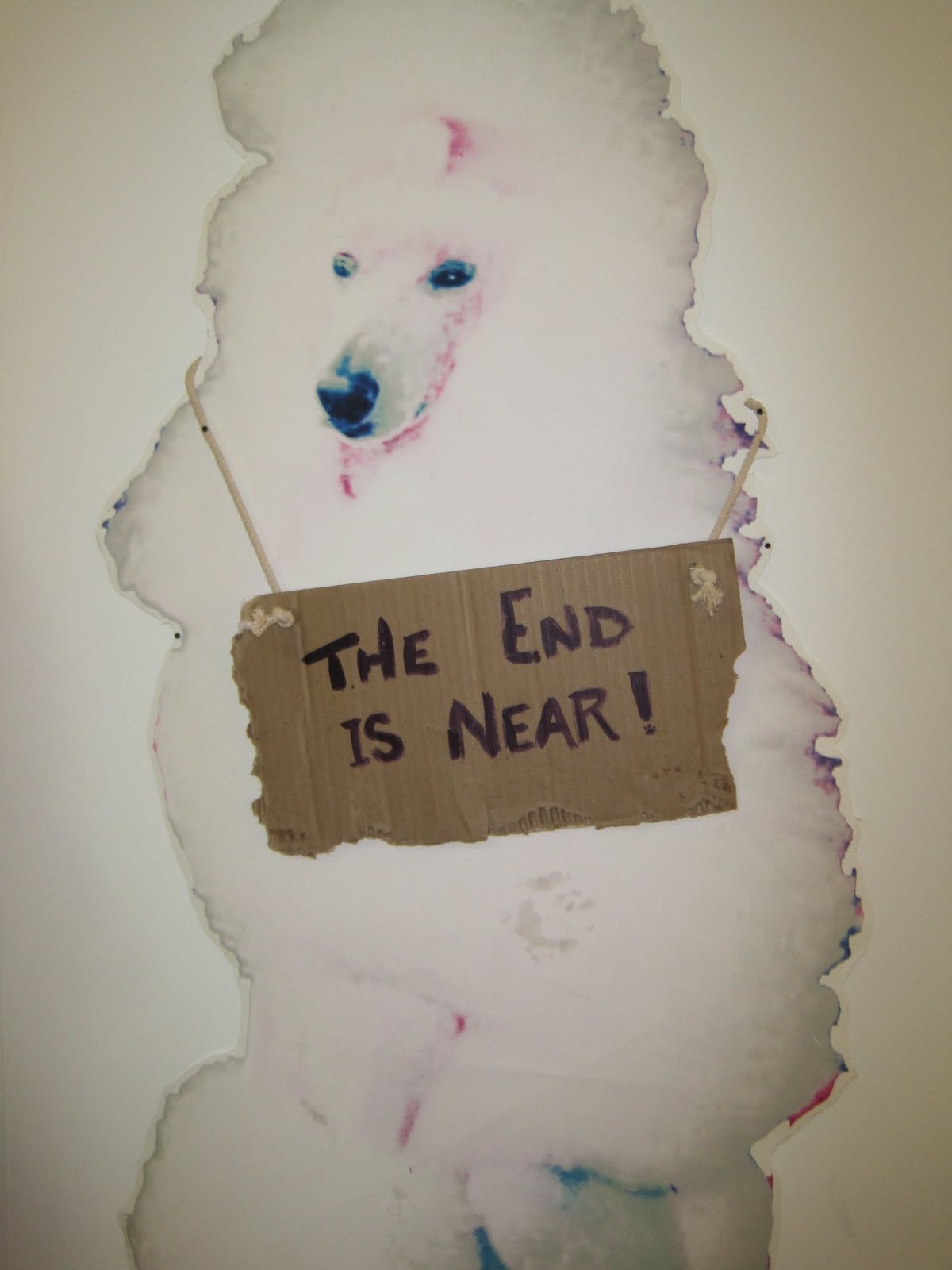
Art work at Art Chicago (apologies to the artist).


My favorite piece at Art Chicago, not just because I'm working on a show about dogs and not just because of the quirky juxtaposition of the fluffy poodle and a doomsday message (May 21st has come and gone and we're all still here).

I am finally tired of the unstable Missouri landscape. I spent a weekend in May at a Frank Lloyd Wright house in Wisconsin--tornado sirens went off there too.

Enough already--let us enjoy our poodles!

Friday, April 8, 2011

Public Sculpture in St. Louis


photo by the author.


Prettiest piece of public art in St. Louis? This canopy by Liam Gillick at Centene's new headquarters in downtown Clayton, MO.

The parking structure (out of the picture, to the right) uses color to mark the levels. While this never makes sense in most parking structures (how many times do you still have to write down the floor number when parking in an urban area?), this one works.

I have no idea what the process was for choosing this artist, but whoever was involved--congratulations! See what a good budget for public art can do?