Showing posts with label contemporary art. Show all posts

Saturday, March 24, 2012

The Armory Rush


Forrest Bess at the Whitney Biennial. All photos courtesy the author.


This Bess photo is a bit skewed because I had to snake around the clutch of folks crowding in on each of the works in this Bob Gober-curated show, the best part of the Biennial. Call me jaded: the objects were not as interesting as the performative gestures. Performa has done a great job pushing NY's museums into recognizing one of the most powerful motivating genres of the post-war period (a little late though, huh?)


Leonard Peltier, Horse Nation, 2011.


Paint-by-number? Native Nations activist / political prisoner Leonard Peltier's work was included in another artist's installation. Irregardless (yes, it's a legal word, look it up) of what the installation was, there was something sad and fierce about this work against the feigned faux works around it (except the Bess). The political bent of the Whitney was coming out--thank goodness. In the arts we've learned that being polite doesn't get us anything--look at how arts councils and tax deductions are being used as a punching bag at the state and federal levels--perhaps it's time to loot and burn, take no prisoners?


Kai Althoff.


I read the labels, I swear! Why did nothing stick? I liked the materials, scale and scope of this. It's an image for you to enjoy.


John Miller, Suburban Past Time, 2012.


John Miller at Metro Pictures investing the middlebrow culture of Middle America. Funny, biting, but you don't almost don't need art to point out the artifice of suburban lives, the tragedy writes itself!


Pae White at The Independents.

One of the best mobiles by Pae--the top of each element was mylar, reflecting the color materials above it. Glorious confusion and movement.

Why do fairs not put names / titles up? I see why galleries at The Independents don't--the space is too wacky, like a tricked out high school gym. There was energy, a crush and some excellent works. Bingo!

Saturday, January 21, 2012

The Beginning of Modern America


photo courtesy the author.

I'm reading Charles C. Mann's book 1491 (thanks to Sanjay Jain, who sent it to me after a very interesting discussion about an up-coming program at Laumeier).

This book is opening up my worldview about the dense, complex web of cultures that existed in the Americas before, during and after first contact. I'm just now reading about Atawallpa, the last Inka leader, whose empire was larger than that of China, the Ottomans and Russia at the time.

While Mann's ideas differ slightly from those of Jared Diamond, I am still shocked that I only heard of Atawallpa two years ago!

The first chapter of the book talked about the People of the Dawnland, Native Nations living on the Eastern seaboard who fought off snooping Europeans for decades, if not centuries. One false move, however, spelled the demise of the Dawnland peoples--due primarily to smallpox and other diseases, but finished off by guns and steel.

The image above is from Cook's baking store in West Allis, Wisconsin. The current story about the first Thanksgiving is not what we were taught in school--sadly, however, the axe seems the constant theme of the white invasion of the United States. No matter that Native Americans helped the Puritans survive, violence fueled by religious discrimination was never far behind a momentary detente.

What I love about the arts is that artists are constantly pushing at the boundaries of knowledge through their asking questions--and this type of tome--1491--fuels some of the most compelling artistic research in today's global cultural dialogue.

Saturday, November 5, 2011

New Orleans Redux


Jackson Square, New Orleans. All photos courtesy the author.

I just logged my fourth trip in two years to New Orleans to continue work on a series of projects linking St. Louis to New Orleans.


Freedom Ride. Image by Joe Baker.

I timed my visit to see the first three acts (the work awaits more funding to be completed) of Freedom Ride, an opera by Xavier University professor Dan Shore commissioned by friend and Longue Vue House and Gardens Director / Chief Curator Joe Baker. The Freedom Riders drove from Washington to New Orleans to defy the segregation of interstate transportation. Edith and Edgar Stern, founders of Longue Vue, hosted the group when they arrived in the South. Edith founded the opera program at Xavier, another elegant connection in this program.

The opera was magical, the powerful voices of the singers evoking the hope and anger of people soul-tired of waiting for their civil rights.

It is hard not to layer issues of race and class when visiting the South, particularly in this economic climate and post-Katrina. While not every artist needs to explore these issues, it's hard not to look for kernels of connection when viewing Prospect.2, which also opened the same weekend as the opera debut. Through reviews of friends who attended Prospect.1, and through the press I read, it sounded as if the first iteration had much more funding. Lack of funding, however, doesn't explain the problems I observed in Prospect.2.


Dan Tague, Crisis Car CC829, 2011.


Sadly, the worst of the installations were in two of the biggest institutions in town. At the Contemporary Art Center, where Prospect founder Dan Cameron used to work, was work by Dan Tague alongside some compelling works by local and international artists, but the whole experience felt disorganized and disgruntled.

I have not be impressed by the shows I've seen at the CAC--is it lack of will, lack of standards, lack of expertise? I am sure there was a lot of local anger at how diverse and global Prospect.1 was--does Prospect.2 suffer because Cameron was obliged to capitulate to local demands and sensibilities?


Jennifer Steinkamp at the New Orleans Art Museum.

Jennifer Steinkamp's haunting, moving trees in a niche at the top of the lobby stairs at NOMA was glorious--too bad the whole thing was washed out by the light of the lobby. The other works that hung on the lobby's walls felt like an after-thought, a concession NOMA made to Prospect.2 without truly giving over any real gallery space. Why wasn't the Odili Donald Odita mural that was going up by the cafe included in Prospect.2? It felt as if NOMA gave over its least art-appropriate space, and grudgingly at that, in order to be listed on the Prospect.2 letterhead.


Sophie Calle in the 1850 House in the Vieux Carre.

Works placed inside other types of institutions seemed to fare much better by being given a context within which to live. Sophie Calle's multi-room installation in the 1850 House put her self-involved stories into an historical space. But Calle's modern narcissism seemed rather trite alongside the issues of slavery, immigration and disease that are animated through the stories of the people who lived at the 1850 house.


Ragnar Kjartansson, The Man, 2010

Ragnar Kjartansson's video The Man was not commissioned by Prospect but was a 2010 collaboration between the artist and musician Pinetop Perkins, the last of the Delta Blues musicians. Was this location chosen as a subtle comment on the role of African Americans in driving the economy of the South, with the blues being subversive resistance of the economic exploitation suffered by African Americans? Subtle thinking indeed, but at least the work was lovely and haunting.


Nick Cave at the Newcomb Art Gallery, Tulane University.

Nick Cave and Joyce Scott were paired at the Newcomb Art Gallery, and although I am not interested in Scott's work and Cave's work speaks to me, there were enough interesting ways to think about the two that the pairing was not disheartening in the way some of the other group shows were.


Joyce Scott at the Newcomb Art Gallery, Tulane University.

Finally, one great public art piece I saw was Michel De Brion's work Majestic, curated and produced by The Third of May Arts, Inc., a Canadian producing collaboration.


Michel De Brion, Majestic, 2011.

De Brion used old New Orleans city lights to make this work parked under the shadow of the freeway overpass in the tangle of streets bisected by the badly designed freeways. Like a pick-up-jack, I thought about the dislocation and re-ordering of the landscape of New Orleans because of Katrina, and the ways in which the city continues to try to put itself back together again. This work was a lovely surprise, stuck, as it was, in this no-man's land.

What a tough balance Prospect.2 had to navigate--how to concentrate installations / art works so that more people can see them while allowing the type of commentary of engaged public art that gives relevance to a biennial in a place as complex and contested as New Orleans? Prospect.2 seems to have galvanized more local activity. I picked up the first issue of Catalogue, which listed the various galleries and public art works happening around town. Surely that alone is a good thing, giving voice to the non-institutional voices.

I am eager to see what the next version of Prospect will be if simply to see how new genre public art can re-invent itself at each iteration.

Friday, June 24, 2011

Politics in Venice, part 3


Street poster in Venice. All photos courtesy the author.

Again, more politics. This poster was plastered around San Marco, looking like Elizabeth Peyton except for the text. After looking for anti-Catholic posters in Venice I found a lot of interesting things--Venice, perhaps because of its independent stature for so long, wasn't a friend of Rome. Anyone know who did this work?


Song Dong in the Arsenale.

China's Song Dong remains one of my favorite artists with whom I've worked. I commissioned him to do a work for my show Water, Water Everywhere... at the Scottsdale Museum of Contemporary Art. His work is thoughtful and meditative, like this ramshackle construction that suggests a labyrinth and a soon-to-be-destroyed warren of alleys. Several works were also embraced inside the walls of this construction--hiding out or finding other meanings?


Liina Siib in the Estonian pavilion.


In her project Woman Takes Up Less Space in the Estonian pavilion, Siib challenges the assertion in Estonia that since women take up less space they can be paid lower salaries. In the un-fancy apartment Siib creates tweaked rooms with the images and words of Estonian women jumping off the wall. The work was funny and very sad.


Faycal Baghriche in The Future of a Promise.

Loved this madly spinning globe by Faycal Baghriche. It reminded me of Charlie Ray's spinning disc set flush into a wall--its effects almost invisible but certainly deadly.


Maria Rosa Jijon in the Latin American pavilion in the Arsenale.

Finally, one of the compelling political videos in the Latin American pavilion.

Friday, June 17, 2011

Politics in Venice, part 2


Llyn Foulkes, Central Pavilion. All photos courtesy the author.

Imagine my surprise to see a room of Llyn Foulkes works at the Giardini. This under-rated LA-based painter has made powerful, disconcerting works since the 1960s. His presence made me appreciate the diligence with which Bice Curiger curated the show (although not sure that the historical works in the first room of the pavilion made sense).


Erwin Wurm.

Erwin Wurm's skinny house, just beside the Accademia bridge, is based on his parent's home and mocks the over-consuming lifestyles in the West. This modest profile fits with Venice however, a city where even the most grandiose palazzo doesn't match the egregious waste of resources or space of a modern McMansion.


Yael Bartana, Polish pavilion.

The presence of an Israeli artist in the Polish pavilion is an example of inspired national cross-over. Bartana imagines a political movement in Poland that begs Israelis of Polish descent to return, re-populate the country and save Poland from a death of homogeneity. One would understand Israeli's not falling for it, but the language was blunt and overt, bemoaning the evil act of killing Jews or forcing them to flee during World War II. Very interesting timing for this work.


Christian Marclay, Arsenale.

I finally got to see at least part of Christian Marclay's work about time. I read all the NY reviews of the work and finally understood the operatic, deeply meditative pleasure of the work. We passed our time with the piece from 2:25 to 3:50 pm, resting on the (uncomfortable) couches yet mesmerized by the ease with which I created mini-historical narratives I made up while watching.


Segalit Landau, Israeli pavilion.

Finally, Segalit Landau's lovely installation looking at water politics in Israel was both sweet and stifling. Through different videos she narrated the struggle for cooperation between political enemies for the appropriate management of water. This video, of a little girl tying together the shoelaces of negotiating politicians, made the most pertinent point--everyone is tied together whether they like it or not, so harming one's enemy is harming oneself.

Simple but effective.

Wednesday, June 15, 2011

Beauty in Venice, part 1


Gondola in Venice near Rialto Bridge. All photos courtesy the author.

Politics and beauty may be the two organizing guides I had while in Venice. Yes, yes, Venice is beautiful. I read that 58,000 people live there while 15,000,000 visitors inundate the city per year. No wonder the city is sinking with all those well-fed Western European and American visitors.


Yuan Gong, Arsenale.

I found beauty everywhere. This gorgeous installation by Yuan Gong was a floating palace of dreams, a respite from the slogging through the Giardini (and a calming influence before the bad few shows that were to follow).


Shada & Raja Alem, Arsenale.

This decorative piece was hard to comprehend in the dark; a floating disc of black loomed above an oval carpet of patterns. A visual interpretation of experience at Mecca perhaps, or a not-so-subtle commentary on the dampening effect religion has on the intricate web of relations between people in the Middle East?


Raafat Ishak, The Future of a Promise.

Raafat Ishak's multi-paneled painting in the Pan-Arab show interpreted the hundreds of requests made for visas and his rejection by this many governments. This playful Easter egg hunt was soothing yet fragile in its delicacy--surely reflecting the fragility of the situation lived by immigrants across the world seeking a better life.


Karla Black, Scottish corollary pavilion.

I loved this installation by Scottish artist Karla Black despite feeling I had seen this type of installation decades ago in LA. This fugitive, diy-craft-y material installation both harkens to the 1960s feminist movement and the 1980s LA garage-style works shown at places like FoodHouse. The aesthetic has seeped into art schools across the country. As a Scottish artist her aesthetic reference must be different--this is the kind of detail that was missing in the written materials at the show.


Oksana Mas, Ukrainian pavilion.

Speaking of eggs, we found this installation by Ukrainian artist Oksana Mas in a church near La Fenice. The artist used thousands of painted eggs to re-create a Byzantine mosaic of Christ. This year I saw more art works based on religious forms than ever-before--interesting that artists are commenting on the (perhaps hollow) overwhelming presence of religious life in Venice.


Taibamo, Japanese pavilion.


Taibamo's enveloping video animations are disconcerting dreamscapes where land and water merge and reverse positions. The gooey tentacles of seaweed caress and obscure in this mesmerizing but somewhat confounding installation.

Long live Beauty!

Saturday, June 11, 2011

Politics in Venice


Horse statue in Venice. All photos courtesy the author.


What a relief to see a lot of art and to see a lot of artists dealing overtly with political topics. This year's Venice Biennale was of a minimum guaranteed quality (except where it was shockingly bad), but that sometimes makes for a sluggish show overall. I was thrilled to get a jolt of recognition through works addressing a range of contemporary issues although not each work was equally successful.

I espied Verrocchio's Colleoni Monument, started in 1479, while taking refuge under an umbrella to escape a hot day slogging between far-flung pavilions scattered around the city. Colleoni is a master of the universe but Verrocchio presents us with a brutish boor of a conquerer. (Art has always been political in some form or another, and denying that make the speaker seem very dull indeed.)


Adel Abidin work in the Iraqi pavilion.


I found Adel Abidin's video and installation a funny antidote to Verrocchio's conquering hero. Two white guys play Star Wars with fluorescent tubes from the office ceiling light; the choreographed dance made a nice mockery of the powers fighting over (name one) Middle East country.


Ahmet Mater.

Ahmet Mater's work in the show The Future of a Promise mocks the simplistic political creed of the former US government that started two wars in the Middle East.


Allora & Calzadilla tank.


Jennifer Allora & Guillermo Calzadilla's installation Gloria at the American pavilion too made hay with politics. The sub-theme was war as competitive game. The best of their work is performative, which meant that some of the more static sculptural works were a bit inert without the animating presence of gymnasts.


A & C ATM machine / pipe organ.

This ATM machine drew a lot of attention and was evidently the most-used ATM in Venice for a few days!


A & C video.

I found this simple video the summation of Allora & Calzadilla's pavilion. The divided screen, the struggle of the men to stay horizontal was elegant, painful and provocative.

I was proud of the choice at the pavilion--there are so many deserving artists in the US but the choices were feeling like a queue for a job rather than an informed, or even inspired, challenge of what art can mean.


Lee Yongbaek, Korean pavilion.


Lee Yongbaek's work at the (South) Korean pavilion had some very nice work and some very bad work. This simple video, of old technology pulling new, seemed to capture the historical squeeze we are in today. We rush into the future with our new technologies without understanding old technologies and relationships. We embrace war without taking into account the impact on the conqueror and the conquered--war disrupts and destroys both societies in different ways, but destroy is the key word.

It was a pleasure to think beyond my own green box while in Venice, to feel re-connected to what artists around the globe are thinking and doing. Art can connect us across political and social boundaries, and given the precarious state of the world, we can use more politically-charged art.

Thursday, May 26, 2011

A Month in the Mid-West


Art work at Art Chicago. All photos courtesy the author.


Whohooo! This funny video work by an artist at Art Chicago (I should have been taking the label pics but did not, I apologize to this artist) is an unintentional bracket to the month I've just had.


Lambert Field after tornado strike.


A tornado hit Lambert Field just after I took off for the weekend, luckily they re-opened the next day so I was able to fly in Monday morning. This may be the only upside to an under-utilized airport.


Mats Stjernstedt in bamboo back yard.


Friend and colleague Mats Stjernstedt, former director of Index Gallery, Stockholm, current director of Kunstnernes Hus, Oslo (I've even been there, twice!) and member of Laumeier's International Advisory Council, visited STL. He gave a gallery talk on Jessica Stockholder's show, conducted studio visits and participated on my panel at Art Chicago concerning new sculptural practices and changes for dedicated sculpture parks. Peter Tao, of Tao + Lee Architects, knows the owner of this bamboo backyard in U City.

What a haunting, lovely yard. Downside: you couldn't have kids, the bamboo shoots were like spikes jutting from the ground.


Theaster Gates in his home / studio / performance space.


One of the smartest artists / cultural workers is Chicago-based Theaster Gates. A group of us (me, Kevin Miyazaki, Mats Stjernstedt and NY-based critic and pal Lilly Wei) went to Theaster's studio at the invitation of Kavi Gupta. Theaster has purchased several houses on the south side of Chicago with the intention of creating a vibrant cultural space in this neglected neighborhood.

Theaster is planning a collaborative project for next year's Documenta that involves a group of his south-side neighbors traveling to Kassel to convert a building there. Stay tuned.


Sculpture panel at Art Chicago, May 1.


I organized a panel on changing sculptural practices at dedicated sculpture parks and other arts organizations. Left to right: Dr. Matthias Wascheck, former director, Pulitzer Foundation, St. Louis; artist / activist Theaster Gates; me, talking about Beverly Pepper's commissioned work Cromlech Glen at Laumeier; Dennis Kois, director, deCordova Sculpture Park and Museum; missing, Mats Stjernstedt, director, Kunstnernes Hus, Oslo. We talked about new artistic practices, like Theaster's, and how they are being manifested in spaces like Laumeier, deCordova and elsewhere.


Philip Guston at Art Institute of Chicago.


And a break to run through the Art Institute of Chicago's permanent collection show. Guston, someone whose work makes me sad and happy at the same time.


Mark di Suvero at center in white hat, deinstalling work at Laumeier.


Mark di Suvero has been a presence at Laumeier since it opened in 1976. He recently won the Presidential Medal of Honor, and is having a show of his work on Governor's Island (I gave the Board Chair, his wife and a St. Louis collector a tour of Laumeier last fall). Here Mark is, overseeing the complicated deinstallation of a work, in-between two cranes and lots of strong, and strong-willed, guys. Fun to watch--from a distance.


Ursula von Rydinsgvard at Laumeier.


Laumeier continues working on a collections assessment which includes refurbishing and reinstalling Ursula von Rydingsvard's Untitled work. She chose this great location near the Estate House (see the stakes in the ground?) This gives us the opportunity to clear out this area near a small non-functioning pond, pour a set of stairs for easier public access and to animate her work by sending visitors through it. Ursula is a great artist and fabulous person who deserves all the attention she is getting these days.


Next generation: Tea Makipaa
.

These are the five foundations poured for Germany-based Finnish artist Tea Makipaa's work. The six-part piece, called Not Without My Dog, has been commissioned for our show Dog Days of Summer. The piece is designed from a dog's perspective and is part of our investigation into an "archaeology of place." Over 20% of Laumeier's audience comes with their dog--thus, we are focusing on our long relationship with them and how it has changed since the mid-19th century. June 25 - October 2. Tea will be at the opening to speak, she'll give us some great insight into her process.


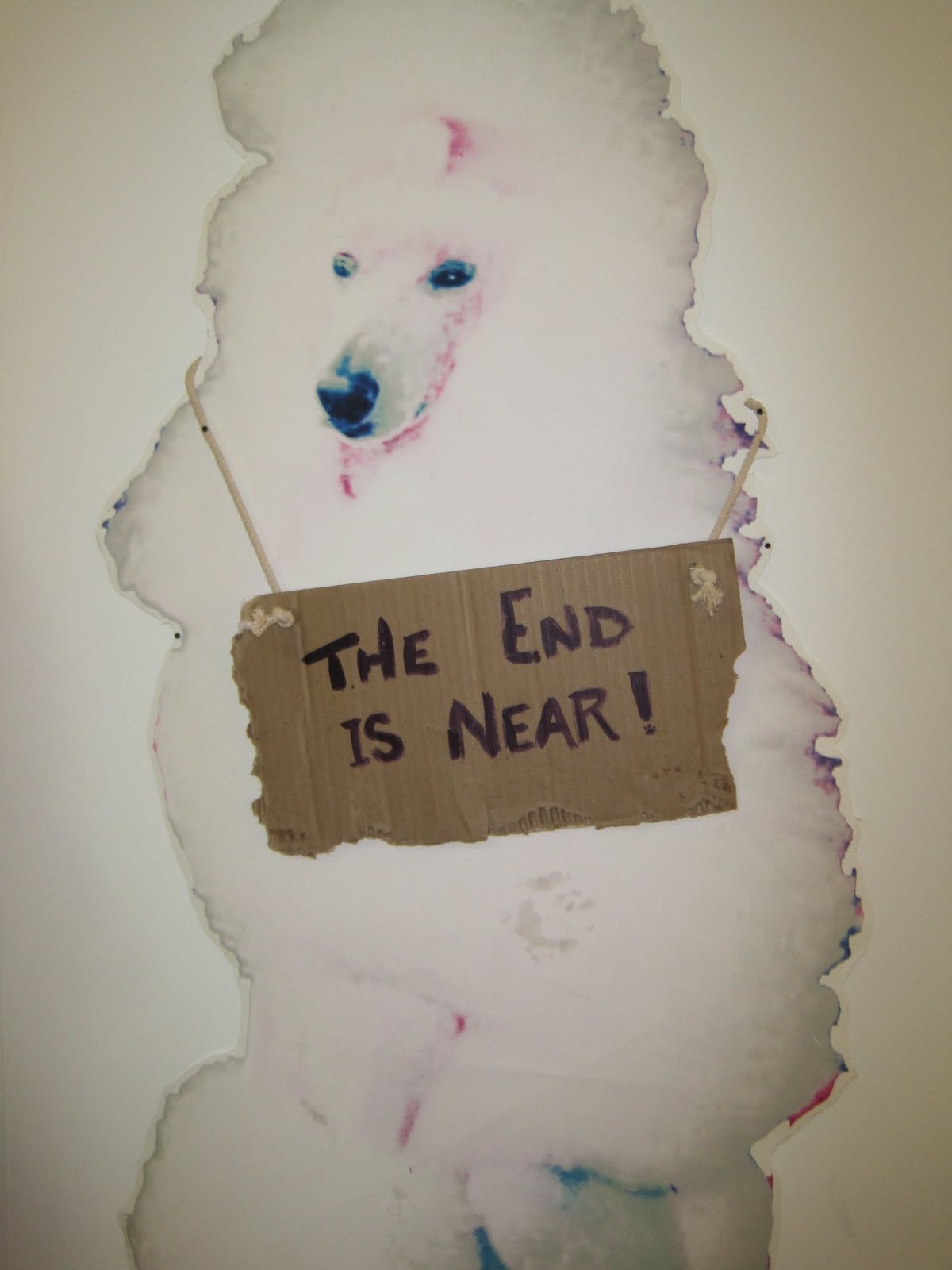
Art work at Art Chicago (apologies to the artist).


My favorite piece at Art Chicago, not just because I'm working on a show about dogs and not just because of the quirky juxtaposition of the fluffy poodle and a doomsday message (May 21st has come and gone and we're all still here).

I am finally tired of the unstable Missouri landscape. I spent a weekend in May at a Frank Lloyd Wright house in Wisconsin--tornado sirens went off there too.

Enough already--let us enjoy our poodles!

Saturday, August 14, 2010

Poor Farm ahoy!


The Poor Farm, friends out front. All pictures by the author.


I spent the last weekend of my Milwaukee vacation with partner Kevin J. Miyazaki (see his blog post), friends Mary Louise Schumacher (her post) and Diane Bacha (her blog), Ken Hanson and John Koethe up in the Waupaca, Wisconsin area to attend the opening weekend of The Poor Farm, an art / educational laboratory by Chicago-based artists Michelle Grabner and Brad Killam.

The three floors (and several projects outside, which I didn't see because of the frightful mosquito quotient) featured a series of artist projects, poetic meditations and mini-surveys of the work of Moira Roth, a much-honored art historian who has chronicled and participated in the feverish events of the American avant garde since the 1960s.


Michelle Grabner and Moira Roth, with knitting chair by Modesto Covarrubias, The Knitter, 2007-2010, behind.

We were lucky to walk through the spaces with Moira to understand the conceptual rooms of her mind and career, seeing how the seemingly-disparate artist projects reflected a disciplined and curious art historian's work.


Poems by Moira Roth, pictures by Slobodan Dan Paich.

I had most recently read Moira's work when doing a project with Nancy Spero, but hers is a career that has influenced countless generations of artists and art historians looking to make sense of the world through art.


History room.

One of the recently cleaned-up upstairs rooms of the 8,000 square foot former farm for the indigent (then a retirement home) housed a set of overlapping, intertwined history that feminist historians like Roth brought to legitimacy in the arts.

Books and texts focused on the 80th birthday of African-American artist Faith Ringgold; documents by Mary Jane Jacob and Russell Lewis on the Women's Building in Chicago, 1893; 19th century African-American history ranging from the tale of escaped slave Caroline Quarlls (who took the underground railroad to Wisconsin, a free state) to W.E.B. Du Bois; to a scattering of documents on the history of Native Americans in Wisconsin.

Roth, Jacobs and Linda Nochlin (who wrote a lovely poem about not being able to make it to Waupaca), are pioneers in a multi-layered multiculturalism which is at the heart of my curatorial practice.

The quiet, meditative quality of the weekend was underscored by the pleasure of lounging around outside drinking Veuve Cliquot and talking with really smart artists, art historians, poets and designers. Wisconsin is a great laboratory these days.